Showing posts with label Undergrad students. Show all posts

Sunday, February 2, 2025

Not your Ma'am

 Reflections on a few things that I was thinking about in January:

1) Not your Ma'am

The other day, someone on X (formerly, Twitter) left a reply on a tweet. Soon after that, they left another tweet apologizing for not addressing me as "Ma'am". This made me think more about appropriate ways of addressing faculty members, senior colleagues, peers that we are communicating with for the first time, and of course, people with whom we interact on social media. At IISER, several students address their teachers by their first names. But, many students prefer sticking to the time-honoured tradition of "Sir/Ma'am".  

Professional, polite and mutually respectful interactions involve more than modes of address. While it's not exactly rocket science, this aspect does involve more effort than choosing a form of addressing each other. It includes, for example,

A) writing emails with complete sentences, 

B) showing up on mutually decided meeting hours on time or letting the other person know in advance of any delay or change in plans, 

C) making reasonable requests (such as informing the instructor well in advance if you are requesting for a reference letter, providing them all the documents that will help them write the letter and following up closer to the deadline), and 

D) learning to conduct smooth discussions on matters of disagreement (such as when the student and the instructor differ on the grades that the former should receive, or when two colleagues have a difference of opinion).

The above contribute much more to an atmosphere of academic freedom and meaningful exchange of ideas than choosing (or not choosing) to call someone by name. 

Some (not all) of my senior colleagues insist on being called by their first names, and can even be a little fanatic about it. They feel that if a younger person is addressing them with titles and honorifics, it will prevent them from freely sharing their thoughts. The younger folks do not necessarily believe this to be the case. I have never held back from expressing my views based on how I am addressing the other person: obstacles to free expression usually arise from how the other person reacts, especially if they are in a position of power over you. 

At the same time, I can see a distinct advantage in insisting early on that your younger peers call you by name. When former students and mentees become colleagues, it is unbearably awkward to continue to be called "Ma'am" by them . But, it is also awkward for the younger person to change the mode of reference.  Nevertheless, the change has to be made, and it's probably easier to do it sooner than later [1]. 

It is totally okay to call your instructor by name (especially if you are making an effort on Points A-D, where the real work lies). It's even more okay if you pronounce/spell the name correctly.

2) The choice will make itself

The spring semester is a time of great churn. Our second year BS MS students are now in the process of making a decision about what they want to major in. The PhD admission and postdoctoral application season has started. Many people, while navigating between different entrance exams (such as NET, GATE, NBHM etc) and multiple applications, are trying to determine whether they want to walk down the academic path or consider alternative careers. In many cases, there are at least two options that look equally attractive. In some cases, one option seems to be what they really want, whereas the other option appears to offer better worldly benefits. A common conundrum among students who talk to me is to choose between majoring in physics versus mathematics. "I like both the subjects, and the thought of choosing one over the other is causing me a great deal of anxiety and FOMO," said a student. 

As the person in most of these conversations who has been through the process a "few" more times than them, my advice is that they keep brainstorming the advantages and disadvantages of each choice. That they use this as an opportunity to sharpen their decision-making powers by considering multiple angles and perspectives. That they also use this as an opportunity to draw within themselves to recognize (possibly for the first time) what will personally make them happy. I am reminded of a silly dialogue from a movie that had come out when I was about to start my Master's. "Close your eyes," said a character to another. "Who do you see? That's the one for you." Go ahead, adapt this principle to your career choices as well, I joked with a student. Close your eyes, and imagine you are in a beautiful, cosy study room with a big window and a view of beautiful mountains with sunlight filtering in. There's a hot cup of coffee next to you. What do you see yourself doing? "I see myself working with a pen and paper," said the student. To me, that pretty much seals the choice. But it could also mean theoretical physics, the student suggests. 

One cannot deny the absolute importance of individual agency in making life decisions. An unrelenting, thorough reflection on our choices sharpens our logical reasoning, mental resilience, and self-awareness. It gives us the courage to take complete responsibility for our choices (to completely "own them", in popular parlance).  But what finally happens is also based on several factors beyond our control or current knowledge. Can you predict that a pandemic will break out? Can you possibly foresee a diplomatic storm ensuing between your country and the one you wanted to study in? Did the flight/train to your job interview get cancelled [2]? Did the professor you wanted to work move away soon after you joined the university?

On a more pleasant note, while you are more or less ready to move to Field A, you may suddenly end up listening to a beautiful lecture in Field B that will miraculously change your mind. You may meet a wise person during a journey or a conference (or both) who will make you re-evaluate your priorities [3]. 

One must think carefully about all of our choices. At the "moment of reckoning", however, it is highly likely that the choice will make itself. 

3) Give it time

Social media recently erupted with discussions about 70 hour and 90 hour work weeks. Such discussions often touch a raw nerve, as most of us navigate multiple demands on our time, and there is always unfair judgement on what we choose to allot less (or more) time to. 

If we sign up for something or accept a responsibility, there is no substitute to giving it the time that it needs. Every aspect of work, personal or professional, needs time. We hope that before taking something on, we carefully consider the time that it will take, and then take a call based on the availability of time to us. But, more often than not, a task takes longer than we thought it would, and as functioning adults, we do our best to rise to the situation. 

Solving new problems or proving new theorems is that aspect of a mathematician's work that takes much longer than one thought it would. We lose track of time spent on it, and I have never heard any scientist complaining about the amount of time it took them to finish a project: this is often narrated with pride and joy. On a similar note, I have never met a colleague or friend in academia who complained about devoting time to preparing good lectures, either for their courses or for conferences/seminars.

There are other parts of our job which also take time: peer review (including referee reports for journal submissions, writing reference letters for job candidates and PhD applicants), committee work, and mentoring students who may not be directly working with us but reach out for support or guidance. Our reputation is built on the integrity with which we execute these tasks, and all of it directly depends on how much time we allot to it. 

In the last few years, I have blogged a lot about learning to bring structure and consistency over long periods of time to meet goals that seemed challenging. Occasionally, I have also reflected upon how long it takes for growth to happen and for something to come to fruition: a research idea, a book, or career milestones. My personal growth and mental health have skyrocketed after I made a simple pact with myself: that I would give any task the time that it needs without judgement or anxiety. 

It seems that both the industry leaders who brought up the issue of work hours wanted to encourage their employees to have ambitious goals befitting their abilities, and devote the time needed to meet those goals. Instead, at least one of them ended up issuing statements that sounded condescending and even crass. Framing your views thoughtfully before communicating them also takes time.


Footnotes:


[1] The Bengalis seem to have evolved a working solution to this problem: they follow the middle path, and simply add "Da" or "Di" while calling older people by their names. This can remain constant even as one graduates through different career stages,

[2] This has happened to me. On a January morning several springs ago, I boarded a flight to go for a job talk in another city, but the flight never took off. The runway was being used by some aircrafts for Republic Day practice. 

[3] Yes, it does sound over-the-top, but both have happened to me, and to some others I know.


Sunday, March 17, 2024

Tales of a teacher

A few days ago, I realized that I have now been teaching for 20 years. I taught my first course in the Spring of 2004, as a 23 year old PhD student. Once the teaching committee at my university identified grad students who could do a reasonable job on the blackboard and were ready to face large classes, they would give us an option to either teach a full semester course, followed by a teaching-free semester, or perform teaching assistantship duties such as marking and tutoring for both semesters. I chose the former option. My very first course as an instructor was in the year when I was to take my comprehensive examination, which would determine if I could stay on for a PhD or not. 

This was a service course in linear algebra for a class of around 80 students: most students taking the course were from other departments, and had to take this as a required course. Many students were in the senior years of their programme. So, it turned out that many were older than me. Some had decided to start or resume university studies after several years: in some cases, their children were in university at the same time, and would help them with the assignments. I continued to see this phenomenon through all the years that I was in Canada. Teaching in Canada gave me a chance to experience their culture in a unique setting. I also learnt how much these people valued politeness, kindness and sensitivity. On one occasion, for example, an older student was concerned that I was looking unwell, and offered to drive me to the medical clinic, as there was heavy snowfall outside. Students would regularly show up for office hours, and apart from working on their assignments, we would occasionally discuss other parts of our lives: this is how the class came to know that I was getting ready to face the dreaded comprehensive examination. On the day of the exam, a large part of the class showed up for the "public" part of the exam: the research proposal had to be presented in a 20 minute presentation. They probably did not understand any part of the talk, but showed up to support and encourage me. I deeply value this memory. 

I taught again the next year; this time, I was teaching a course in Complex Analysis to 100+ engineering students. In complete contrast to the previous class, these were a bunch of brats: this was the only class I've ever taught where I had to request students to not whistle in class [1]. After a few lectures, a sombre mood prevailed in the class. Complex Analysis has this effect on most of humanity. We started getting on well, and the course proceeded smoothly. One other crazy experience with this batch was on St. Patrick's day (or was it the morning after?) While half of the class was absent, the other half showed up drunk. Let's just say that thanks to this class, I had the "now, I've seen it all" moment quite early in my teaching life! No other batch of students has come close to putting me through what this class did.

The year after that, I was getting ready to defend my thesis. I was again assigned the same course in Linear Algebra that I had taught before: this time, the students got to know about my defence date [2], and some showed up for the public presentation. To make the presentation more relatable to them, I kept using words from linear algebra such as finite dimensional vector space, diagonalizable linear operators, basis of eigenforms etc (in the context of my thesis work, of course) which made some members of my defence committee smile. Incidentally, my class was scheduled soon after the defence, but I had requested a friend to cover for me. While the students sauntered down the hall after the presentation, she waited outside the defence room while I went through the closed-door exam. We cut a celebratory cake with some other friends after I was declared a "Doctor", and she ran down to teach my class, while I sat numb and dazed in the lounge [3].

My teaching reviews that semester were filled with congratulatory messages. In these reviews, I got some of the earliest reference letters of my career: several students recommended that I be hired as a "full-time" professor. 

My first faculty position (or as my former students would put it, my first position as a "full-time professor") was at IISER Kolkata, which was then functioning out of a temporary campus on the ruins of an older university. For my very first course, we did not have a classroom. So, some chairs were arranged next to a board in a computer lab. While the students were excellent and super-motivated (one of the best things I like about being at an IISER), one vague memory I have is of the director or some HOD often walking into the lab with a prospective faculty candidate to show them the computational facilities. The candidate would often shoot a confused glance when they saw me lecturing to a handful of students, while people worked on their computers in the other half of the room.

For the next batch, I managed to get a classroom. It had a pillar right in front of the board. Every single day, I had to resist the temptation to swing around it like Shah Rukh Khan in Swades (in case you don't know which scene I am talking about, watch here from 2.25 onwards). Sometimes, clueless goats and cows would wander into our classroom. I was fortunately spared the experience of snakes entering the classroom (they seemed to have a preference for labs, hostels and faculty homes, including mine). On one occasion, due to a failure of coordination between IISER security and that of the university that we were functioning from, the building gate was locked with all of us inside. Again, I have a vague memory of it raining and the mobile networks not working: so, it took a while for someone to come and let us out [4]. The good thing is that with all these shared experiences, this batch and I developed a special affinity: students from this batch still call me up or email me on Teachers' Day, and also stay in touch with me. 

Soon, I moved to IISER Pune. Almost all my teaching has happened here. In the 20 years since my first course in the Spring of 2004, I've now taught all kinds of courses at many levels: from first year undergrad to PhD students, with class sizes ranging from 2 to 200, including general, introductory courses, standard courses for math majors, specialized topics courses (one of which led to writing a book) and PhD-level courses. Fortunately, I never again had to deal with students whistling in class, or showing up drunk (not that I know of, anyway). I occasionally see people scrolling on their phones or falling asleep: but that is okay, as long as they do not disrupt the class. 

The pandemic teaching was an entirely different experience: for nearly two years, I lectured to an empty class, my lectures were recorded by the staff members from our Science Media Centre (who, surprisingly, never fell asleep in the lectures) and the recordings were shared with students. 

One of my most recent experiences was in Autumn 2023, when I taught probability to a large class of 200 students. I was curious about this experiment: I was teaching probability for the first time, and to a batch of students who had finished the last few years of their school in online mode due to the pandemic. In addition, many of our students in the early years have not had mathematics in Classes 11th and 12th. The course had its challenges, but was successful overall. In fact, the teaching reviews indicate that I seem to have taught long enough to develop a sense of humour.

In complete contrast, this semester, I am teaching a course on Fourier Analysis to a small class of 7 math majors in the fourth year. Thanks to their previous preparation and high motivation levels, we finished more than 90 percent of the syllabus before the midsem. So, we now have the freedom to explore more advanced topics. I am using this opportunity to learn a new topic and teach it to them as well, namely Fourier analysis and the theory of uniform distribution on compact topological groups. Fourier analysis mostly focuses on one particular such group, namely the unit circle. From what I am learning so far, showing it all as a special example of a more general theory makes the treatment of the subject neater and more elegant. 

This course (and the larger experience of teaching over the last 20 years) has taught me how closely intertwined the experiences of self-study, learning and teaching are. May this go on.


[1] "Request" is a euphemism. My exact question was: "Am I in a university class, or a fish market?" The whistling stopped, but some students told me later that they were confused by the allusion to a fish market. This seemed to be a uniquely cultural phrase, that is more relatable to Indians than Canadians. 

[2]  From their super-chatty prof, naturally :-)

[3] In retrospect, I suppose I could have pushed myself a little more to teach the class as well.

[4] If you visit the sophisticated, permanent campus of IISER Kolkata today, you will have no inkling of how it was in the early days.


Thursday, May 28, 2015

On motivation and competence


A commenter to the previous blog post, Aravind asks the following question:

“From my experience of a KVPY interview, I understand that you look for motivation in candidates. How do you assess motivation? How much of it figures in the final score? And what about competence?”

Motivation and competence are strongly related. A high score on a school board exam displays a certain level of understanding of textbook content. But a competent student doesn’t just work to score high marks: she will spend time in thinking about what she learnt, would seek conceptual understanding over a mechanical one and will keep practicing an idea beyond what textbook exercises demand. This competence can only be developed if the student is motivated enough to think of the subject as something exciting and not something on a “to-do” list [1]. Regarding your other question of how one assesses these qualities, I am afraid there is no standard procedure: otherwise we would have coaching institutes training students for these interviews as well [assuming they don’t already exist].

If other readers of the blog have a more substantial answer to Aravind’s query, comments would be highly appreciated!


[1] I am not discounting the competence required to approach a to-do list in an organized manner and accomplish all items in it in a timely manner!

Monday, April 20, 2015

Meeting your past self

My last few posts about summer projects were light-hearted ones about the kind of applications one gets [1].  Sometimes, students also suggest interesting topics to work on (see footnote [2] of this post).


Before laughing at students, it makes sense to recall how one was at their stage.For example, when I was informed about my selection to the MTTS programme at Level O, I wrote to Prof. Kumaresan asking about the books I should bring for this programme.  [Those who know him and are familiar with MTTS will understand that this is the worst question one could ask him and I was, later, suitably reprimanded for my "perverse" thinking :-)].


When I first sent in my application toTIFR's VSRP, it was hand-written, I addressed Professor Balwant Singh (who was the Dean of School of Mathematics at that time) as Mr. Singh and said that I wanted to attend VSRP in order to get some "on-the-job" training in "high-level" Mathematics.  Prof. Singh, of course, let that pass! I did get in: and I honestly don't know what I would be doing now if I had not spent that summer (and two more summers later) there studying basic (not "high-level") algebra, analysis and point set topology under the watchful eye of many faculty members [2].


As one of the commenters to that post, TTE, points out:

``Ah! Starry eyed students :) how they annoy us now (or at least annoy me). Sometimes I wonder if they annoy me, not because they are naive, but because I am scared to meet my past self."


[1] I have got some addressing me as "sir", even "bhaiya"!

[2] But, my fondest memories are those of Professor Sridharan (the senior one) walking into the VSRP room and asking me questions about whatever I was studying at that time.

Thursday, June 28, 2012

Intelligent course designing

Recently, there has been much introspection at N1 about its undergraduate programme.  The first two batches of our undergraduate programme have done very well and most have got into prestigious PhD programmes all over the world.
While there is much appreciation of this fact, it is also felt that in the current course structure, the performance of students in the first two years has not been up to the mark.

Naturally, some are questioning whether our current process of admitting students, in the quest to fill up the number of seats specified by MHRD, is compromising on the quality of students.  This question assumes special importance in the current national debate concerning the IIT entrance exams.

The other question that people are asking is whether the current course structure of our undergraduate programme is the best structure to provide a strong foundation to our students in the sciences?  Is this system optimal from the point of view of the students? Has this system been fair to the students that we do get? Can we make our programme more accessible to our students without diluting our courses and without compromising on the objectives of our institute?

In the current system, students take a broad variety of courses in the sciences in the first two years  and choose a major subject in the third year (though they also continue to study interdisciplinary courses).  Thus, in the first two years, the students have to learn enough about different sciences to be able to develop a broad perspective in science and make an informed choice of their major.  The primary challenges in this system are

a) the jump from class twelfth to the first year of this programme.  Since each discipline is only represented by one course per semester for the first four semesters, a lot of material needs to be covered to prepare the students for the intensive courses that they take in the third year.  Many students are unable to handle the pressure at this early stage.  For example, students who opted for Biology in 11th and 12th now have a hard time keeping up with their peers in their first year Mathematics course (and vice versa).

b) Once a student decides to major in a subject A in the third year, she again has to make a big jump from what she studied in A in the first two years and the advanced material that she sees now in the third year.  Does one course of A each semester in the first four semesters adequately prepare the student to make an informed decision about choosing A as a major and then undertake five intensive courses of A each semester in the third year?  Keeping this in mind, when instructors try to ensure that students in the first two years have the necessary pre-requisites for year 3 by following a challenging course syllabus, many students experience burn-out.


There was some serious rethinking about these matters from the course-structure point of view rather than the quality-of-student point of view and various remedies were suggested.  Somewhere between the extreme of narrowing down a student to one subject in the first year itself and that of making all courses "gentle" was found the right balance.  Basically, the incline from one year to another has been made more gradual.

As per the new structure, which has now been approved by the senate,
a) Just as before, students will take one course per semester in each of the sciences in the first year.
b) In the second year, students will now choose three sciences of their interest and take three courses per semester in each of the chosen subjects.   These courses will be more rigorous than the first year courses.
c) In the third year, the student will choose a major from among the three subjects chosen in the second year.

The new structure has generated enthusiasm among many faculty members.  We feel that it gives us more space to introduce the most fundamental aspects of our fields in the first two years in a way that students have enough time to follow and digest what is being taught to them.  

Each department now has the fundamental task of redesigning the first year course and introducing appropriate new courses in the second year.  The next couple of weeks will be spent doing this as the new plan will be put into action in the coming semester.

I would like to hear from readers about the undergraduate course structures at their institutes in the initial years and their thoughts about it, either as a student or instructor (or both).


Tuesday, October 25, 2011

Roller coaster

Last month has been a roller coaster ride for me, both personally and professionally.  It started with incidents which made me seriously evaluate my professional needs and personal well being at N1 vis a vis what N1 expects from its employees.  There were also some episodes,  specific to an expanding new institute, which were sometimes exciting, occasionally frustrating and sometimes, just confusing.

This post is going to be about a lot of things because I am not focused enough to just write about one issue right now!

Immediately before Dussehra, I found myself spending a lot of time in committee meetings. Now, in principle, I have nothing against committee meetings - a lot of them are about framing or revising rules and regulations about various aspects of N1, for example, our academic programmes, disciplinary code of conduct, various issues that come up as an institute moves from a transit campus to a permanent campus, faculty welfare etc.  I have gained valuable experience by being actively involved in these committees and like my other colleagues, have been able to bring up many important points which I feel strongly about.  The only thing that I don't like about these meetings is that they take precious time away which could have been spent in research work or preparing for a class.  But, I don't think it is reasonable to complain about this because there are other members who have many more responsibilities than I do.

I also get routinely inundated with a lot of complaints from students about various problems.  I sympathize very much with students and bring up their genuine problems at the appropriate forums as soon as they are brought to my notice.
However, sometimes there is a delay in the resolution of the problem partly, because administrative procedures take their own time and partly because the authorities concerned may not take the problems as seriously as one would want them to.  Students, on the other hand, become impatient and want quick fixes!   Recently, I have had to be very firm with some of these students, asking them explicitly not to interrupt me when I am on my way to a class and also not to call me up at night unless there is an emergency.  Then, they are quick to jump to the conclusion that faculty members do not care for them.  This is very annoying.

The Dussehra holidays were very eventful for me, personally.  My brother got married and it's great to have a new member in the family.  It was also a lot of fun to meet many family members and cousins who I meet only during weddings!
During the wedding, I was given the responsibility of co-ordinating with the guest house where all our relatives were staying and also arranging for pick up and drop off of all guests.  According to my father, I was most suited to do this task because of my experience with organizing conferences and hosting seminar speakers at N1!

After I returned to N1 after the wedding,   I got some great news from the department.  We have been given a lot of money by the institute and will now be able to spend comfortably on a lot of things that we wanted, for example, our own library and new high-end computers for the department!  I am particularly excited about having the freedom to invite lots of rock star seminar speakers from all over India.
We will also host another winter school in December.

In a few minutes, I will leave for my home town to celebrate Diwali with my family.  I was initially planning to stay back at N1, but last night, I realized that I have not spent Diwali with my family since 1999 and it just doesn't make sense to be in the same country as my family and still spend it alone.  So, I made last minute flight bookings and surprisingly, got a really good deal!  I am looking forward to all the fun we will have at home,  to spending time with my sister-in-law and also, to possibly catching Ra.One (that is, if it manages a Diwali release).

Here's wishing all my readers a very happy and auspicious Diwali !!


Saturday, August 27, 2011

Winter school - conclusion

Our winter school was very successful.  Dr Rock-Star, the primary speaker, was absolutely delighted to see a large number of enthusiastic students for his lectures.
The topic on which he was lecturing is a very important topic in my field, and the available literature on this subject follows a certain approach.  However, he chose to convey the subject matter using a very different approach, which is elegant and more easily comprehensible to students.  He had not previously communicated much to me about his lectures and I realized on the first day that the problem sets that had been previously prepared (following the traditional approach) for tutorials would not match his lectures.  So, every morning before his lectures, Dr R-S and I would sit together and prepare new problem sets.  I have to admit- he was the brain behind the problems while I mostly typed them out and solved them.  I think I enjoyed this part of the winter school the most.  This new approach to the topic has also generated some interesting research problems and has been a valuable addition to my research programme.
The tutors played a very important role in the whole school.  They have not had any previous experience in teaching and took on this responsibility with a very positive attitude.  The material presented in the lectures was also very new to them.  They would take the problem sets from me just after Dr R-S's lecture everyday, work on them during the lunch hour and tutor the students in the afternoon.  According to the feedback forms that we later received,  the students highly appreciated the effort put in by these tutors.  I wish them a successful academic career ahead!
Our participants, as I mentioned before, were a healthy mix of students from IIX institutes as well as colleges and universities.  From the feedback received from them, it seems that most IIX students saw this winter school as yet another opportunity to do something exciting in the winter vacation.  Many of them applied to it because they were encouraged by the faculty at their institutes who were aware of Dr R-S's contribution to this field.  On the other hand, most of our university student participants had not heard of Dr R-S before and their primary motivation in applying was simply to experience the scientific atmosphere at a research institute.  The students unanimously felt that they got much more out of the lectures than they had anticipated.  This is possibly because instead of just attending lectures, they worked out the material in the lectures by themselves in the tutorials.  Another interesting feedback we received was that university students found faculty at N1 much more friendly and easy-going than those at their universities.  They probably would have had the same impression at most IIX and research institutes.
Dr R-S's visit and the winter school has been a great boost to our baby department.
Many students from N1, who attended these lectures, have now decided to major in my STEM field.  Even those students who have not done so have benefited from these lectures and have now become regular visitors to our department seminar.
Dr R-S enjoyed the visit very much and will be visiting us again in the coming winter.
Last, but not the least, my colleague from the last post, has now overcome his health problems.  Although his primary research interests are different from mine or Dr R-S's, he attended the lectures and enjoyed them.  He is very excited about the positive impact of such visits to N1 by senior scientists and we are both planning more workshops/winter schools in the coming years with external funding.  I hope that more colleagues will catch on to the spirit and join our efforts to make our department at N1 active and vibrant.


Sunday, August 21, 2011

Mission winter school

Before continuing with the winter school story from my last post, I quickly went over it.  The frequent use of the pronoun "I" instead of "we" irked me and possibly irked the other readers as well.  Let me clarify - I am not a megalomaniac.  Nor do I lack in team spirit.  There were three of us who initially planned the lecture series.
However, by the time the plan was put into motion, one of my colleagues was battling a serious health problem while the other colleague was dealing with some personal issues which significantly engaged the colleague's mind and energy.
Moreover, since Dr Rock Star has been my academic mentor, it meant a lot to me that his visit should be a success and that he should return with a good impression of N1.  So, I ended up planning the event myself (although with a lot of help from the admin staff).  Hence the use of "I" more than "we".
Nonetheless, I do acknowledge that I have a serious problem in asking for help.  I tend to take on more responsibilities than can be handled comfortably[1].  Recently, I made some serious mistakes because of this tendency to bite off more than I can chew and have learnt, since then, to ask my colleagues frankly for help and also to say no to something I am unable to do(though I must admit, I say it rather tactlessly and sometimes to the wrong people, but more about that later).
Coming back to the topic at hand, the whole event was shaping up very differently from what had been initially anticipated.  Ideally, workshops/instructional schools should be planned and announced at least 4 to 5 months before the event so that by the time the participants are invited, they have enough time to book their tickets.
However, in this case, the announcement was sent out only about two months before and it was exactly a month before the event week that the "selected" participant list was ready [2].  At this time, a tragedy occurred - due to an unexpected server problem, some of us lost all the emails in our N1 email account.
I was among these unfortunate few [3].  Not being a very computer savvy person, I had not created a back-up and therefore, lost all the contact information of the selected participants [4](their email addresses had been clubbed together in my address book, which I also lost).  However, since I was "personally invested" in this mission and 25 is not such a big number, I remembered the names of all the participants and which institutes/universities they were from.  It was easy to retrieve the email addresses of students coming from research and IIX institutes.  Not so for university students.  Fortunately, I remembered the writers of their reference letters and it was easy to contact them and ask them to send me the email addresses of these students.  So, this crisis was somehow averted and important lessons were learnt regarding data management as falling back on memory is not always a viable option.
All invited students, except one, confirmed their attendance.  Around this time, I announced Dr R-S's visit to students at N1 again and about 25 students expressed an interest in attending these lectures.  So, we now had a nice audience of about 50 students ready for the lectures, with four of them being PhD students, willing and able to run tutorials.  So, it seemed more appropriate (and also more fashionable) to call this a winter school.  The budget was approved, all required rooms in guest house and hostels were reserved, the registration packages for participants were ready and a bus was arranged to bring students from the train station at scheduled hours.  A big lecture hall was also booked.
Around a week before the arrival of the speaker, I started receiving emails from more students at N1, who wanted to attend the winter school.  Since the lecture hall can accommodate a very big number of students, there was no problem in them attending the lectures.  However, it was too late to register them for the winter school and therefore, we could not give them the registration package (which included meal coupons).
In the 48 hours preceding the first day of our winter school, a few strange and unexpected things happened.  An undergraduate student from an IIX institute, who had not applied before, wrote to me out of the blue that he would be attending the event and that he had already booked his train tickets for N1 city.  I was highly irritated, but could not do much because by the time I received the email, he would have already boarded the train to N1 city.  I did not have the heart to refuse him hostel accommodation on his arrival, but I did have a talk with him about winter school application etiquette.   I would like to hear back from readers what they would have done in such a situation.
I also got a panic call from four female students coming from a college in Delhi.
These students had made their booking together through a travel agent, who booked their train for a wrong date.  They realized this only on reaching the station and by then, it was too late for them to book another train.  So, they had no option available except to come by flight the next morning.  This was not such a big problem for me - the shuttle bus driver was instructed not to wait for them at the train station and pick up arrangements were made from the airport.  However, on the day of their flight, they called up again to inform me that this flight had got canceled and that the only flight available was a late night flight.  Due to a shortage of institute vehicles, at such short notice, I had no option but to hire a vehicle(Tata Sumo) from a private operator known to me. The father of one of the women spoke to me and said that he had apprehensions about the girls arriving at N1 city at such a late hour and being received by a private taxi driver.  I sympathized with his concerns, but was at my wits end.  At that time, I remembered that most students at N1 are usually up till very late at night.  I called up two second year students, who had volunteered to help me with organizing the event, and asked them if they could accompany the Sumo driver and receive the girls.  These two boys, of course, jumped at the opportunity.  The father was now sufficiently reassured.  Needless to say, the girls arrived very late, but safely and comfortably at N1.
All students had now arrived on campus and we were ready to begin.
Okay, so the post has again turned out to be much bigger than I thought.  What's more, I am visiting my family this weekend and my disciplinarian father is mortified that I am blogging so late at night.  I will continue the story in my next post.


[1] As a child, I once asked my teacher to make me a class "monitor".  But, once she did so, I found myself unable to do even simple things like opening a Godrej almirah, in which we stored our books etc. 
[2] Some students, who could have really benefited from these lectures, applied after the deadline.  Sadly, I was unable to invite these students because we had already reached the numbers approved by the administration.
[3] All our lost data was indeed retrieved later, but by then the winter school was over.
[4] I had put together all their email addresses in my address book the previous evening, with the intention to send out the invitation the following morning. The server problem happened overnight.  In my (misplaced and ill-timed) effort to save paper, I also did not print out the applications of students, but kept track of them online. 

Monday, August 15, 2011

How an informal lecture series became a winter school

Happy independence day to all Indian readers!
Today, I would like to write about an activity at N1 last year that I thoroughly enjoyed organizing.
After I joined, some colleagues and I felt that it would be a good idea to invite a distinguished scientist in our field to visit us for a week in the winter and deliver some lectures that would be accessible to students.  This was a vague idea, but no one had any concrete suggestions.  Apart from the above qualities, we needed a speaker who would be willing to spend a week at a new institute like N1 at a time when almost all institutes in India organize their conferences/workshops etc.
One of my academic mentors, let's call him Dr Rock Star, maintains very close ties with India and frequently visits different research institutes here.  He has done some really good work in my field and also happens to be an excellent teacher.  He was one of the people who offered me a lot of encouragement when I decided to join N1 and had even expressed a willingness to visit me some time.  So, he seemed to to be the "ideal" candidate for our mini- lecture series.  Our director immediately approved the lecture series.  I wrote to Dr Rock Star, who happily accepted our invitation.  However, as his schedule is usually very packed, we did not have a lot of flexibility in coming up with dates.  He simply gave us a block of five days in which he was not scheduled for any other event and we had to plan our lecture series within those days.
The immediate challenge was that the last three of those five days were coinciding with an international conference at N1 that had been planned months in advance.  I also came to know that there was another symposium coinciding with the first two days of our proposed lecture series.  This symposium had been announced before I joined N1 and I was not made aware of it until after Dr Rock Star confirmed his dates.  Given the space and resource constraints at N1, I found myself in an uncomfortable situation.  I felt that I was trying to bull-doze my way through events which had been carefully planned months in advance.
Fortunately, the organizers of both the conference as well as the symposium had no such qualms and fully co-operated with me. We sat together and figured out the room allocations for all visitors of the three events and luckily, our guest house had just the right number of rooms available to house all faculty participants of the three events as per their dates.
The second challenge (or so I thought) was to get student participants for our lecture series.  At first, my plan was to have the lectures only for students at N1.
Sadly, students from my own department were very few in number and did not show much enthusiasm for Dr Rock Star's lectures.  I was scared that he might just end up lecturing to empty class rooms!
I remember bringing up this issue during a departmental meeting, in which the director was also present. I asked him if I could invite about 20 students from outside N1 to attend the event.  He approved this suggestion along with the reimbursement of travel expenses of out-station participants and asked me to get in touch with the accounts section to work out the detailed budget.
That evening, I sent out emails to my colleagues at other institutes in India, announcing Dr R-S's visit and lectures and requested them to forward this information to students from their institutes and universities in their cities/towns who would be interested in these lectures.  I thought that within a few weeks, I might hear from around 20 students who would like to attend these lectures.  I was in for a big surprise! By the next afternoon, I had received about a hundred emails from interested students.  To my amusement, some of the emails were from lecturers in certain colleges who wanted to bring their whole class along for these lectures.[1]
Over the week, I received many more applications.  It was clear that I would have to follow some sort of selection procedure to short-list  genuine participants.   So, I wrote back to all these students asking them to submit, by a certain date, a statement of interest explaining why they were interested in these lectures along with a reference letter from someone who could comment on their academic performance.  This automatically narrowed down the applicant pool.
Apparently, college lecturers who previously wanted to bring their whole class with them did not show any willingness in guiding their students on how to write a statement!
By the deadline, I received about 30 "complete" applications from students from various universities and IIX institutes.  These were mostly undergraduate students, but some of them were in Master's programs.  Some of these applications had to be rejected because these students, applying from the same department, had just cut-copy-pasted the same statement!  Other than these, I invited all other students.
They were about 25 in number, including 4 PhD students.
Meanwhile, I announced Dr R-S's visit again to our students at N1.  This time around, I received a much more positive response.  25 students expressed interest in attending these lectures.  Apparently, when I had sent the previous announcement, many of them had not received it due to a server problem and hence the poor response!
So, there would be 50 student participants attending these lectures.  It was much more appropriate to call it a winter school now.  The 4 PhD students were asked if they would be willing to run tutorial sessions after lectures on each day of the school- they agreed.
At around this time, I went to the accounts office.  After all the horror stories I had heard about accounts sections in government institutes, I was very nervous about dealing with them.  But, they turned out to be  very helpful and friendly.  I had no experience in preparing any kind of budget before and had no idea how to contact caterers, transport providers etc- the accounts office did all this work.  They also pointed out how much expense one would incur on many other contingencies that I had not thought about. [2] One evening, after some discussion, around 5 pm,  our budget was ready. We sent it to the director and by 6 pm, we got a one-word reply from him, "approved".

This has turned out to be a much larger post than I imagined (just like the winter school).  In my next post, I will write about my experience in running the winter school, which is when the real challenges showed up.


[1] The other amusing outcome was that Dr Rock Star started receiving invitations from several colleges in India, from which he had never heard before, inviting him to visit them during his forthcoming visit to India!
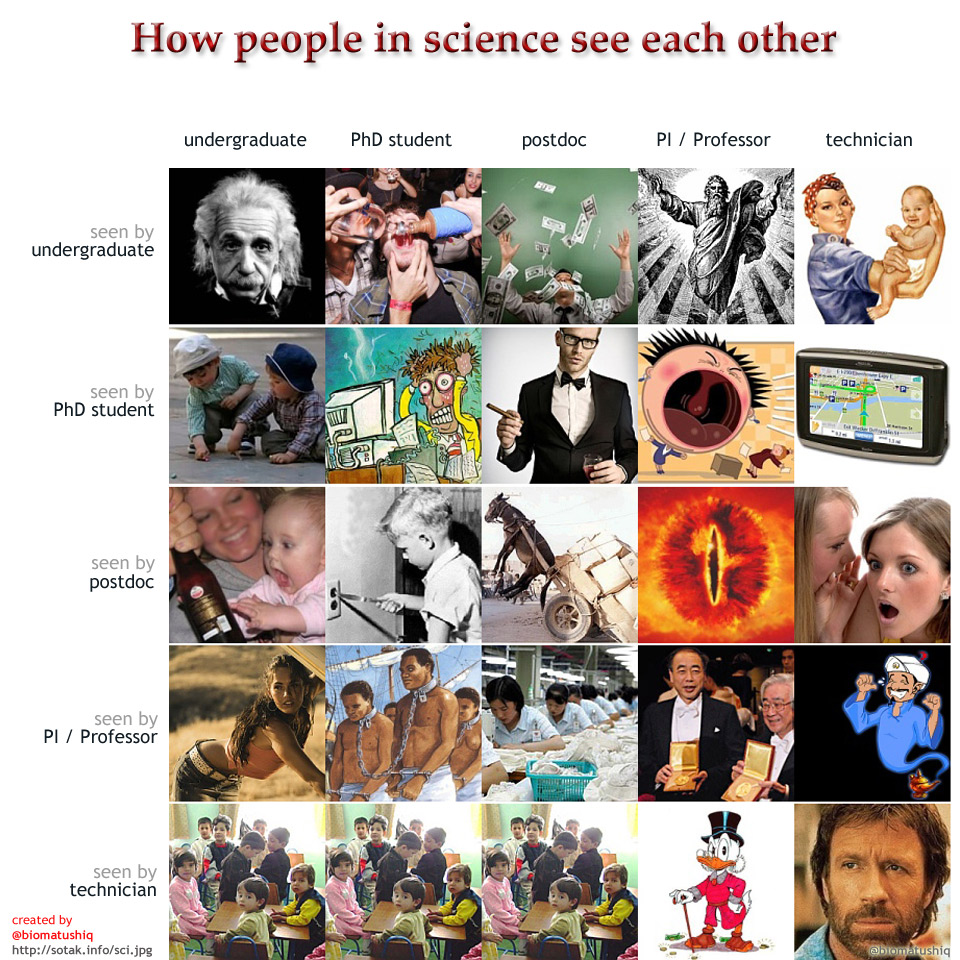
[2] I sometimes feel that it is probably much harder for accounts people to deal with faculty members than for us to deal with them.  If they are not dealing with people like me who dare to organize big events without knowing the basics of writing up a budget, they are dealing with others who try to teach them how to do their jobs! Abi@nanopolitan, in this post has a link to a really nice picture about how people in science see each other.  One could easily replace the technician with the accounts section staff. 


Monday, June 20, 2011

In appreciation of students

The very first batch of students of the flagship program at N1 is ready to graduate.  We have just received details about their future plans. About 80% of the students have chosen to pursue PhD in various disciplines.  The remaining 20% are either starting jobs in the industry or are joining well known management institutes in the country.  Among the PhD aspirants, there is approximately a 60:40 divide between those going abroad and those staying back in India.  The abroad-bound are mostly headed to Europe (primarily England, Germany and Switzerland), with a small portion going to North America.

Since I joined only last year and was away for about 5 months, I have not had much interaction with this particular batch.  But, I am very, very proud of them.  Many students in this batch joined this basic sciences program at N1 despite stiff parental opposition and peer pressure in a culture which still places supreme importance to engineering and medicine.  (Being involved in student affairs, I once met the mother of a student here who has been on anti depressants ever since her daughter joined N1 because her bright child will not become an engineer).  Being the first batch, these students have also survived the initial infrastructural rough patch at the institute.  On top of it all, they also did not have any precedent about future career choices.  They had reasons enough to complain.  Yet, not only have they performed well and carved their future paths, many of them have written to faculty members thanking them and saying that joining N1 has been a great experience for them!  
Here's wishing them all the very best! 


Thursday, June 9, 2011

Meeting the students

An important task for me this summer is to mentor the eight summer students working with me.  We met last week and planned out activities for the next two months.

The first meeting with the summer students was very interesting.  Out of them 6 are in their second or third year of undergraduate program, while 2 are Master's students.  Depending on their previous course work and interests, I have divided them into four working groups studying four topics.  Our plan is to have biweekly seminars, which all the students are expected to attend.  In the first seminar, I will give a talk on one of the four topics, and in the second meeting in the same week, one student from the working group doing this topic will give another talk on it.  The intention behind getting students to talk is to ensure that they are working regularly and understand the concepts well enough to explain them to an audience.  Since the audience only has me and the other students, they will also not feel intimidated.  Also, although each group is expected to focus on its own topic, this seminar will ensure that they also get a broad understanding of what the other groups are doing. Students will also be working on certain assignments and experiments every week.  
The whole point of the summer program is that the students should learn to work on their own outside a typical classroom atmosphere.  Thus, it does not make sense for me to give standard three-times-a-week lectures.  It is much better that the students work on their own and approach me during my office hours, which have been generously scheduled.  On the other hand, there should be some kind of structure in the program so that I can ensure that the students are working and sufficiently involved. Hence, the biweekly seminars.  
I guess I am essentially designing the program on the lines of VSRP at the Tata Institute, with the modification that students will also give talks and that they are younger than VSRP participants.
The whole plan seems to work fine at the moment.  The students are regularly meeting me during office hours and are taking a lot of interest in their topics.  I am waiting to see how they do their assignments (or if they do them at all) and how they plan their talks.
I am also hoping that the regular seminars will inject some life into our currently very sleepy department as many of the faculty are traveling this summer.  
Non-program interaction with these students has been a lot of fun.  One of these students seriously believes that he is the next Messiah who will revolutionize the way science is taught in the country.  It is great to have dreams and ambitions and I applaud his noble intentions. However, I hope that he will learn in the next two months that one has to know a bit of science before bringing about a science revolution.
Yet another student was hoping to work on a project which is sort of my STEM field's equivalent of splitting the atom! Once again, I do not wish to discourage him. But, he is certainly not working on that here with me.
The other six students have not displayed any abnormal characteristics yet. There is one female student (FS) in this group and the above mentioned two students are trying to "mentor" her (without being invited, of course).  The other day, these two walked into my office to tell me how the reading material prescribed for FS is not appropriate.  I was secretly amused at their "concern", but firmly told them to focus on their own work.  I later thought of some measures to make sure that FS doesn't get stifled under their "care", but it seems that she herself is doing a good job in warding them off.
In conclusion, the summer program is holding up well for now.

Tuesday, May 31, 2011

Choosing summer students

I am now back in India, still sick and under strong medication, which along with the jet lag and extreme heat ensures that I sleep through most of the day.  I will be heading to N1 city tomorrow morning.

One of my important priorities for the coming two months is to supervise summer students. I am doing this for the first time.
Summer students at N1 come in through two main channels: the Indian Academy of Sciences- Summer Research Fellowship Programme and a fellowship programme run by N1 independently.  The objective of both programmes is to give an opportunity to students from all over India, especially teaching-specific universities, to work with scientists at research-based places and get some exposure to scientific research (something that may not be available to them at their universities).  Students from IIX institutes also apply to these programmes because their course work requires them to undertake projects during summer outside their institutes.

Students from the former channel apply directly to the Academy, indicating who they want to work with.  The proposed summer supervisor has no say in the selection process, but has the freedom to turn down a selected applicant upon being informed by the academy.  Two first year undergraduate students undergraduate will be working with me under this category.

Students coming in through N1's fellowship programme write directly to the faculty member with whom they want to work.  I received several such applications this year.  Instead of waiting till the last date of receiving applications and then deciding, I kept responding to the applications as and when they arrived.
I obviously did not expect undergrad students to write long research proposals. I just expected them to tell me about their previous coursework and what topics interest them.  I also expected them to know a little about what I do before applying to me.  As it turned out, even this was a lot to expect.
I received several applications addressing me as "sir" (In India, it is uncommon for students to address faculty members by their first names or even as Dr/Prof Last Name. Sir or madam is the most common form of address.)  I also received many applications in which the applicant expressed an interest in working in a subfield of my STEM field which is currently very hot and fashionable.  My own research area is very different from this research area.  Anyone who visits my webpage can easily figure this out and also that I am not a "sir"!  It was clear that the applicant was sending the same application everywhere and did not even bother to find out who the application was going to.
These applications were obviously rejected.  If this student had prepared a good application in other respects (like a good CV indicating their previous academic performance and preparation), I wrote back to them mentioning that their "research interests" do not coincide with mine.  Otherwise, I did not reply to these emails.
The applications that had me hopping mad looked something like this:

Dear sir,
I wish to pursue higher studies abroad.  Please accept me as a summer student.  Writing a paper with you  with facilitate my application abroad.
Yours,
Clueless Undergrad

While I have nothing against students wanting to go abroad, I don't like students who state this as their main aim in working with me rather than gaining knowledge.  I also do not like students who demand that I write papers with them!  Depending on my mood and available time, I wrote back to some of these students indicating how their application is incomplete and inappropriate.

I did get a few genuine and honestly written applications and in a burst of enthusiasm, I accepted six of these.  
There will be a total of eight summer students working with me this summer.  Most of them are second and third year undergrads who wish to major in my STEM field, but have had little coursework in it so far.  They are expected to study the topic assigned to them, work on problem sets, conduct experiments and submit a write up at the end of two months.
I think I could have done with a fewer number of students. But, now that the decision has been taken, I must do my best to make their stay productive.
I look forward to meeting them in a couple of days.  My next post will be about my strategies for supervising all these students at the same time.
Right now, the antibiotics are kicking in and it's time to sleep (and I have miles to go AFTER I sleep.....)